
Shifting and Tilting: The Right Lens for the Right Job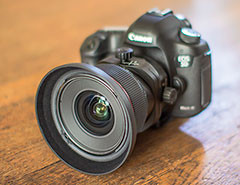 
I used to think that it was less important which lens I used when photographing real estate and more important how good I was with post production software. After all, you can always “fix it in post,” right? Well, I’ve always found that the best and quickest way to find a reliable answer: talk to a professional.
The great ROI benefit to discussing your beliefs with other professionals in the field is how frequently you get reminded that beliefs are not always facts. Once I heard (repeatedly) about the benefits of using tilt-shift lenses and got my hands on a couple of them to test drive, I was hooked.
What are the pluses to using a tilt-shift lens as opposed to relying on editing? This is the discussion between optical versus digital and what your final use of the image will be. I have often made digital perspective corrections in Lightroom or Photoshop and the software does amazingly well. However, use of the software means losing a good chunk of the image, both in terms of the actual crop and the megapixels of the file. Optically, using a tilt-shift lens, I can still apply post production edits to the image but I’m working with the original image resolution. That’s a big plus for me. In addition, there’s the lens sharpness. In order to compensate for the tilting and shifting of the lens, the lenses have a larger than normal image circle which means when set to the zero shift position the edges and corners of the image you shoot are tack sharp. I use tilt-shift lenses primarily for architecture photography but I know people who use them for everything.
There are a few downsides to tilt-shift lens. There are more moving parts than with a conventional lens so you’ve got extra operations to contend with in the field. There is no Auto Focus on a tilt-shift lens so it’s essential that you get get accurate manual focusing. This usually means keeping a loupe with you at all times on your shoot so you can achieve precise focusing using the LCD screen on the back of your camera. (Two popular loupes are made by Hoodman and Matin). Plus a tripod for leveling. Tilt-shift lenses are not inexpensive. They are on the heavy side when you’ve got several of therm in your bag. And you will want several of them in your bag.
Canon sells seven tilt-shift lenses. Nikon currently has four in their PC (Perspective Control) line. As a Canon shooter, I invested in the Canon TS-E 24mm f/3.5L II, an amazing lens that has produced some exceptional images for me. I can’t recommend it enough. I’m looking forward to carrying the weight of a second tilt-shift lens in my bag soon.
Keywords:
canon,
tilt-shift
Comments
No comments posted.
Loading...
|
© 2020 Rick Johnson / Photography Werx